Personal Commandments
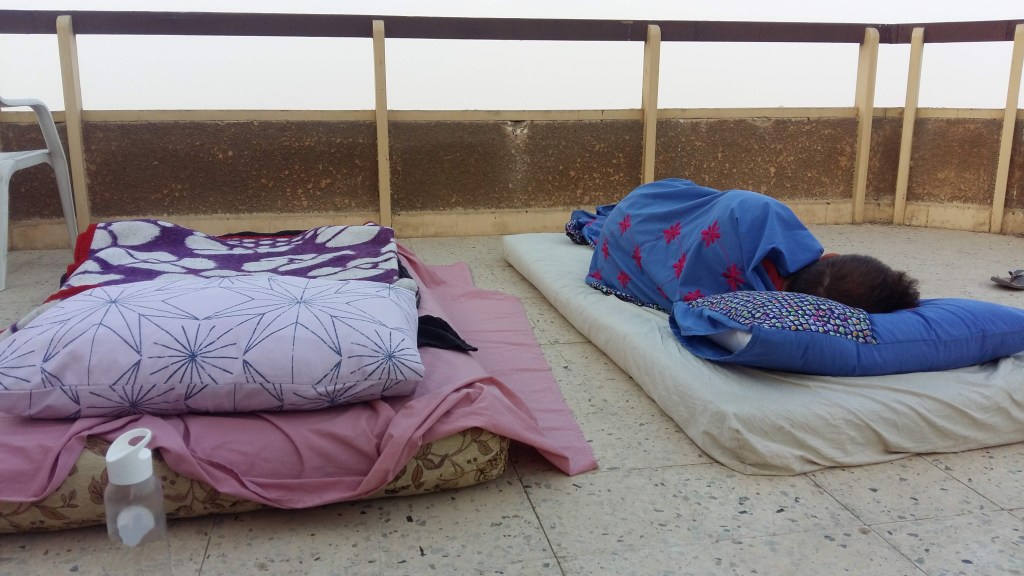
Don’t sleep on the roof. Our leaders had repeated those words a number of times. They had also repeated many other rules that we took more as suggestions.
The problem with following that specific rule was reality. Namely, the reality of the unbearable heat, paired with a shortage of functional fans. Air conditioning was not even in the equation.
With temperatures rising up to forty five degrees, it does not take much to conclude that sleeping on the roof was a rule inconsequential enough to justify breaking.
So, most of the volunteers, myself among them, went up to sleep on the roof. We carried our mattresses up the two flights of stairs, laid them across the concrete roof and slept. It was definitely cooler than our stuffy rooms. Occasionally, there would even be a light breeze.
Yet one thing Egypt has as abundant as the numbers on the thermometer, is desert. On clear days, we could see the pyramids from the roof of the retreat house. Most of the time, we could barely see the parts of Cairo closest to us. The sand would rise up in the air and form massive covers of dust, obscuring everything.
Everyday, we would return home to find a layer of dust covering all the exposed surfaces. During the night, we would be breathing in that same dust.
I was among the first casualties.
After a few days, my allergies spiked, inflaming my throat and sinuses. I returned down to one of the rooms after that. It was horrible.
Many of the others stayed up. One by one, just like I had, most got sick. We had to go to the summer camp, dance, sing and play for hours; with sore throats, flared up sinuses and a variety of other ailments that had also popped up.
It turns out that you really should not sleep on the roof in Egypt.
—
Throughout our lives, we are given many dos and don’ts from people around us. Our parents, our teachers, our friends and authority figures all try to guide our actions in what they believe is correct.
It is important to have personal boundaries and red lines. They make decision making easier. They can also help us remain true to ourselves, prevent us from being taken advantage of and keep us on track.
We need to know what we are okay, and not okay with.
However, there are many rules that have been created at an age when we are too young to understand the complexity of the subject matter.
Toddlers are trained not to poke at plugs, because they would not understand why. Children are ordered not to run in certain places for the same reason. The fact that smoking is bad is drilled in the minds of young teenagers. How would they realise the gravity of the consequences if they are generally suffered at an age three times their own?
Even for adults, conceiving implications twenty years into the future is challenging to say the least.
Yet these simple rules can become daunting when we grow older. Especially if rules remain constant after having been outgrown. It is important for a teenager to be compelled to study by their parents. For a university student, it might be stifling and overbearing.
Moreover, a proper explanation for the rule is often never given. If the rule remains abstract, it can be easily dismissed or become suffocating.
Abstract, badly explained and overbearing rules can be seen as unnecessary. However, they might be there for a reason we are yet to understand. Just like what happened by sleeping on the roof in Egypt. We might be surprised by what happens when we do not follow them.
Therefore, rather than putting traditions and rules into ‘right’ or ‘wrong’ categories, let us inquire into what value we might get from following them, and try to understand why they came into existence in the first place.
Having done this, we can reinforce and live out our values more boldly. Rather than sticking with them because they are what we have been told, we can take them on consciously. Even if we do not fully understand every bit of our values, we can understand that there is value behind them.
Questions:
Take some time to reflect upon the values you hold dear.
What has shaped these values?
What are values you held in the past, but have now discarded.
Why have you done so? Could there be hidden value in what you have stopped?
Has anything taken the place of the values you have stopped adhering to?
Is there something you want to change in your actions? In what you view as right or wrong?
In the absence of a moral code that we understand, we might feel lost in how we should live. We might find it difficult to discern the consequences (both good or bad) of our actions.
Do you know what your morals are?
Exercise: If there is a value you do not understand, but feel is important, ask someone who is more qualified to help you understand it. Just as we turn to a mechanic if we need advice on a car, we should turn to those who reinforce and teach us our values to better understand them. Ask an elder, a priest, someone who has values you admire and who tries to live them out well and discuss your questions with them.
Subscribe to receive an email whenever there’s a new reflection.
 Reflections
Leave a comment